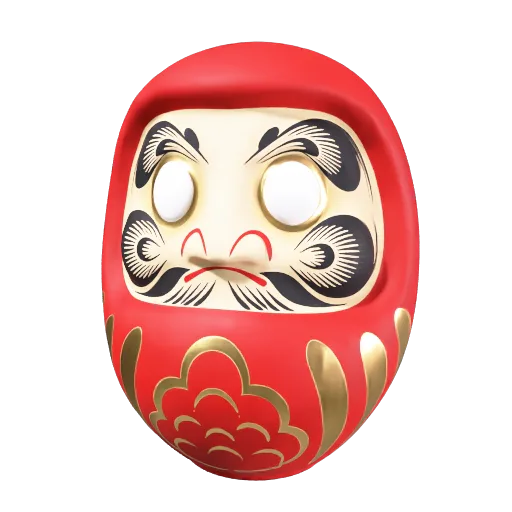
A Japanese figure with a Buddhist model
The name and face refer to Bodhidharma, known in Japan as Daruma Daishi. The later wishing object is related to the monk, but is not the same category.
A PRACTICE, NOT JUST A FACE
A daruma is a Japanese wishing figure modeled on Bodhidharma. Its rounded form is associated with getting back up after setbacks; its unfinished eyes can turn a private goal into something you see every day.
Sources checked 28 August 2026DARUMA IN 30 SECONDS · DIRECT ANSWER
A Daruma is a Japanese wishing figure modeled on Bodhidharma. Familiar Takasaki forms are rounded papier-mâché goal reminders. The object is not a god, a wish guarantee or one design used everywhere in Japan.
The name and face refer to Bodhidharma, known in Japan as Daruma Daishi. The later wishing object is related to the monk, but is not the same category.
On a blank-eye goal Daruma, one pupil can mark commitment and the second the finish. The doll records the cycle; the reader does the work.
Material, body, face, color and eye state vary. Some forms are wooden or begin with painted eyes, so Takasaki rules are not universal.
ENGLISH OBJECT NAME · DIRECT ANSWER
Call the traditional object a Daruma doll. “Figure” is a useful broad description, but “statue” and “toy” should describe the exact product—not every Daruma.
Official English-language cultural sources place Takasaki and Miharu Daruma in Japanese doll culture. This is the clearest name for the folk object, wishing practice and regional craft.
Use “figure” when you are describing the form without yet claiming its material, age, ritual use or safety status. Then identify the maker, region and object type.
Use “statue” for an actual sculptural object. Use “toy” only when the maker or seller documents the intended age and use; a souvenir or display object is not automatically a tested toy.
PLACE & NAME · DIRECT ANSWER
Japanese. The familiar rounded wishing doll called daruma is a Japanese folk object. Its model—Bodhidharma—belongs to a wider Buddhist history connected with India and China, so the person, religious lineage and later doll should not be treated as one national origin.
The e-Museum identifies Daruma as the Japanese name and gives Damo as the Chinese form for Bodhidharma.
Shorinzan Daruma-ji describes the monk as Indian. The e-Museum records the tradition that he came to China from the West.
JNTO documents the painted papier-mâché Daruma as a Takasaki tradition with more than 200 years of history in Japan.
DARUMA RITUAL · DIRECT ANSWER
No. Use the familiar goal-and-eye sequence as a starting point, then follow the maker, temple or place connected to your Daruma. The sources below document real differences rather than one rule for all Japan.
For a blank-eye goal Daruma, choose a clear goal, mark the beginning with one eye, keep doing the work, then complete the second eye at the source-defined finish.
Takasaki City and Katsuo-ji describe opposite viewer-side starting points. Neither instruction should be silently turned into a universal national rule.
Mihara City documents a regional Daruma made with both eyes already painted. That object is not incomplete and does not need a blank-eye ritual added to it.
HOME USE · ANSWER
There is no one national placement rule. Shorinzan Darumaji and the producer cooperative give different responsible answers. Follow the guidance attached to your own Daruma when it exists.
For its Fuku-Daruma, the temple says viewer's left of a kamidana, or above eye level when there is no kamidana.
Boundary: Temple guidance for this object, not every Daruma.
The Gunma Daruma Manufacturers Cooperative allows a visible household place or study desk.
Boundary: Different sources serve different objects and settings.
The cooperative recommends south to east; Shorinzan instead describes household position.
Boundary: A recommendation is not a national feng-shui rule.
RELIGIOUS IDENTITY · DIRECT ANSWER
Not as a simple category. The sources used here describe Daruma as Bodhidharma—a Buddhist monk and Zen patriarch—and the familiar doll as an auspicious wishing figure modeled on him. They do not identify the doll itself as a Shinto kami.
Shorinzan Daruma-ji calls Daruma Daishi a real Indian monk. The e-Museum places Bodhidharma in Zen history and Japanese religious art.
The rounded doll carries wishes, perseverance and good-fortune practice. It is modeled on the monk; it is not the same category as his historical identity.
The temple also gives guidance for placing and venerating its Daruma. So “not simply a god” does not mean every use is secular or identical.
COMMON CLAIMS · CHECKED
Each answer tests a broad English-language claim against a named place, maker or public record. Start with the verdict, then open the exact Atlas evidence or the Japanese source behind it.
Some wish Daruma begin blank, but documented regional forms including Mihara Daruma are made with both eyes already painted.
Evidence limit: This disproves the word “every”; it does not define the eye custom of every maker.
Takasaki and Katsuo-ji describe opposite viewer-side starting points. Use the instruction attached to the specific Daruma, maker or place.
Evidence limit: The comparison covers named practices; it does not map every household or regional convention.
Named Japan-based guides agree on some colors and conflict or stay silent on others. The specific maker or seller’s wording controls the object.
Evidence limit: The Atlas compares four guides; it does not claim those four exhaust every modern color use.
Organized memorials and return practices belong to named temples, shrines, cooperatives or events. Check whether that source accepts your object.
Evidence limit: A public ceremony is not permission for a private fire, postal return or universal one-year expiry.
Aomori Prefecture documents Utoubori Daruma carved from split wood, while other regional files include triangular and parent–child silhouettes.
Evidence limit: One documented counterexample defeats “all”; it does not define every object sold under the Daruma name.
Matsukawa is recorded in Sendai, Miyagi; Matsumoto is a Nagano form whose eyebrows and beard use dyed hemp fiber.
Evidence limit: Similar English spellings are not provenance. A name match alone cannot authenticate an object.
How to read “false”: it means the sentence fails as a universal rule. It does not prove the opposite for every workshop, household or object.
TRADITION OR FICTION?
No—not in the official descriptions used for this guide. They describe the traditional Daruma as a good-luck or wishing figure modeled on Bodhidharma, not as a yōkai or cursed object.
Government and national-tourism sources connect Daruma with good fortune, wishes, perseverance and Bodhidharma.
Manga, films, games and online horror can reuse the name or face. That fictional role does not reclassify an ordinary Daruma.
If a story says “Daruma,” identify whether it means the wishing figure, a children’s game or a fictional character before transferring the claim.
QUICK ANSWER CHECK
No form, account or written feedback required.
Start with the daruma's left eye (on your right when facing it). In this Takasaki practice, one eye marks a wish in progress; the second marks fulfillment or, in the temple's instructions, that a year has passed safely. This is not a rule for every daruma in Japan.
Start with a blank-eye wishing daruma and choose a goal. This sequence follows Shorinzan Darumaji's Takasaki practice; other regional forms may arrive with eyes already painted.
Paint the daruma's left eye (on your right when facing it). At Shorinzan's eye-opening ceremony, the priest makes a small first dot; the temple tells the owner to enlarge that eye at home while making the wish.
Keep working toward the goal while the other pupil remains blank. One eye marks an ongoing wish in this practice, not a damaged or cursed object.
Shorinzan's instructions say to complete the daruma's right eye (on your left when facing it) when the wish is fulfilled or a year has passed safely. Offer thanks and follow the temple's guidance for the particular daruma.
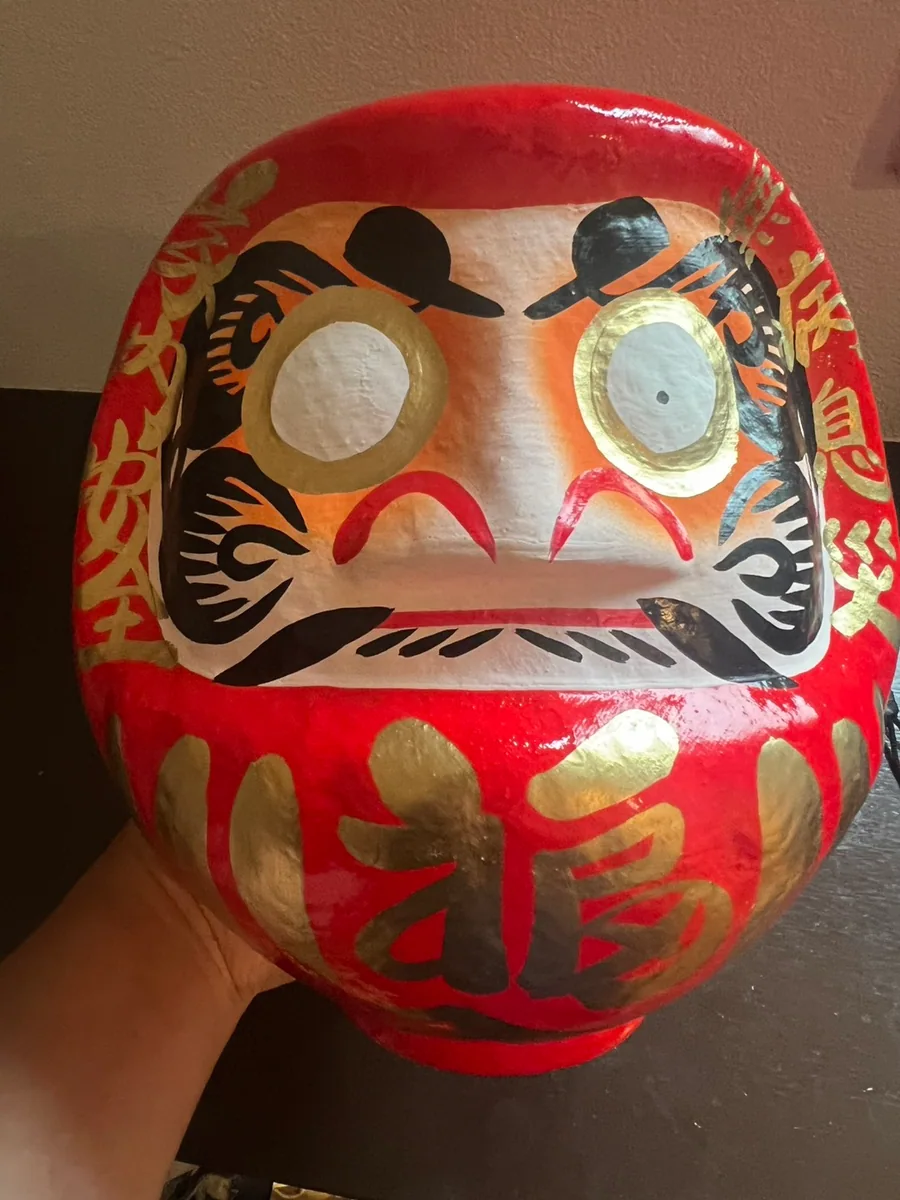
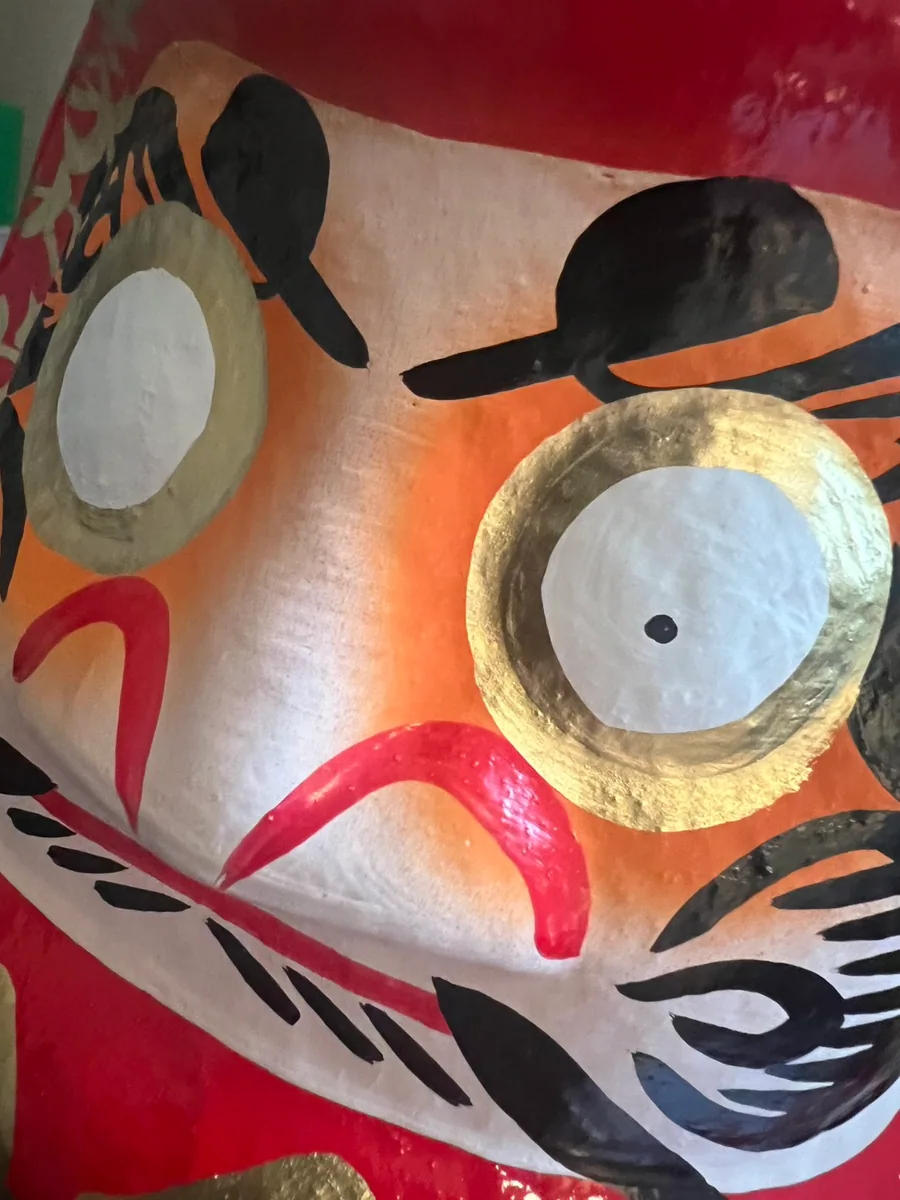
On our visit, a priest chanted and made the first dot. We offered ¥1,000; registration to completion took about 10 minutes. Those are one visitor's figures, not a fee or time guarantee. Photography during chanting is prohibited by the temple's sign. We do not have verified footage of the brush touching this doll.
Read the visit account and contribution guidance. The temple sets no fixed opening contribution; a doll without its prayer certificate has an additional ¥1,000 prayer fee.
Shorinzan's official eye-opening instructions and the supplied temple instruction sheet; checked October 7, 2026. Photographs are unaltered apart from orientation, resizing and web conversion.
DIRECT ANSWER · COUNT THE PUPILS, THEN CHECK THE SOURCE
For a blank-eye goal Daruma: blank means ready to begin, one pupil means the goal is active, and two pupils mark the finish defined by that source.
This is a use-stage decoder, not a national identification rule. First confirm that your object was made for the blank-eye goal ritual.
For a Daruma intentionally sold with blank eyes, the empty pupils leave room to choose one wish or goal. Blank does not mean damaged, unlucky or abandoned.
Name the goal, then check the ritual supplied by the maker, temple or place before painting the first pupil.
A maker guide explains the one-eyed face as a way to keep the original goal visible while you work toward it. The doll is a reminder, not a promise that the result will happen by itself.
Keep the same goal visible and leave the second pupil blank until the source-defined milestone is complete.
Shorinzan's English guide and Takasaki City describe adding the other pupil after fulfillment or a source-defined successful period. Two pupils mark completion within that practice—not a universal label for every Daruma.
Record the result with thanks, then follow the keeping, return or memorial guidance connected to that object.
OLD DARUMA · DIRECT ANSWER
Do not burn it yourself. Close the goal only according to the practice attached to your Daruma, then confirm that a named temple, shrine, maker or event currently accepts the object.
If you are outside Japan or do not know the origin, do not mail it or start a fire from generic online advice.
Complete the second eye only if that matches the instructions for your object.
Check the box, seller, maker, temple, shrine or market connected to it.
Verify object type, timing, fee, wrapping and delivery rules before you travel or send anything.
Gunma's official guide describes completing the other eye after a successful year even when the original wish is still open, then starting a new Daruma to recommit. That is a documented Gunma practice, not a rule that makes every Daruma invalid after twelve months.
Use the timing supplied by the maker, temple or place connected to your object. If none was supplied, do not invent a deadline from a generic article.
The temple says it accepts Daruma throughout the year and performs Daruma Kuyo at Setsubun. It asks visitors to take bags and wrapping home. Normal hours and New Year arrangements are listed separately and can change.
Check the temple page on the day you plan to go. Carry the object only after the current rules still match your situation.
JNTO describes the January 9 festival as a New Year cycle in which old Daruma are placed on a ceremonial bonfire and new ones are bought for the year ahead.
Treat this as a travel and event example. Confirm the current organizer notice and acceptance conditions before bringing an object.
HOW TO USE A DARUMA · NEXT ACTION FIRST
Short answer: set one goal, paint one eye, do the work, then complete the other eye. The exact eye order and what happens afterward belong to the Daruma's maker, temple or place.
Write a clear goal before painting. The first-eye direction is source-specific: Takasaki City begins on the viewer's right, while Katsuo-ji's Kachi-Daruma guide begins on the viewer's left.
Boundary: This guide applies to a blank-eye goal Daruma. A regional figure sold with both eyes painted is not unfinished or incorrect.
ALL FOUR STAGES · NO-SCRIPT ANSWER
The selector gives one answer at a time. This table preserves every stage for direct comparison, printing and no-script reading.
| Current stage | Next action | Do not assume | Responsible sources |
|---|---|---|---|
| Both eyes are blank | Choose one goal, then identify whose ritual you are following. | This guide applies to a blank-eye goal Daruma. A regional figure sold with both eyes painted is not unfinished or incorrect. | Takasaki City — wish and eye sequence; Katsuo-ji — Kachi-Daruma instructions |
| One eye is painted | Keep working; the unfinished eye is the reminder. | The doll is a reminder, not a guarantee. Do not replace the guidance supplied with a temple or maker object with a generic internet rule. | Daruma.jp — use and eye-order boundary; Shorinzan Darumaji — wish and eye guidance |
| My goal is complete | Complete the second eye and mark the result with thanks. | Completion practices belong to a particular object and source. One local sequence should not be presented as a rule for every Daruma in Japan. | Takasaki City — wish and eye sequence; Shorinzan Darumaji — wish and eye guidance |
| I want to retire or replace it | Do not burn it yourself; find the source that will accept it. | An organized o-takiage or memorial is not a universal disposal order. Acceptance, timing, fees, shipping and fire rules can change, so verify them directly before carrying or sending an object anywhere. | Shorinzan Darumaji — Daruma memorial care; Gunma Daruma Manufacturers Cooperative — use and retirement FAQ; Maebashi City — Hatsuichi old-Daruma memorial |
VIEWPOINT TRANSLATOR · NO CAMERA NEEDED
A front view reverses the words people use for left and right. Select the wording in your instruction and the guide will point to the physical eye it describes.
Takasaki example: the doll’s left is the eye on your right. A maker or temple connected to your own Daruma may give different ritual guidance.
That is the eye on your right while you face the Daruma.
Evidence boundary: this tool translates viewpoint words. It does not create one eye-order rule for every regional Daruma, maker or temple.
We checked the Japanese 縁起だるまの由来 leaflet and the multilingual Shorinzan Darumaji visitor brochure brought back from Takasaki. Both are temple publications; the English brochure photographed in the Daimonya folder is not a Daimonya publication. The following is our summary of the temple's account, not independent proof of every origin story.
The brochure also retells Bodhidharma's nine years of wall-facing meditation. That is a religious tradition, not a verified medical account of losing limbs or evidence that a children's game began as meditation training.
Printed materials and temple panel checked October 7, 2026; edition dates not established. Full brochure pages are not republished. Compare the temple's current account · See our temple visit.
WHO IS DARUMA? · HISTORY OR LEGEND
Quick answer: Daruma is the Japanese name for Bodhidharma. The monk, the nine-year meditation tradition, medieval Japanese portraits and the later lucky doll are connected—but they are not one dated event.
Bodhidharma belongs to the early Chan story; detailed biography remains limited.
The e-Museum records a Daruma hanging scroll now held by Tokyo National Museum.
Shorinzan Daruma-ji places its Fuku-Daruma making in the Tenmei-period famine-relief setting.
Choose one familiar statement. The result labels what the sources support and what remains tradition or overreach.
Daruma is the Japanese name for Bodhidharma, a monk connected with the early formation of Chan Buddhism in China. The broad historical core is stronger than the detailed stories told about his life.
COMPLETE ORIGIN CLAIM CHECK
The reader gives one answer at a time. This table keeps all six available for direct comparison and no-script reading.
| Claim | Evidence lane | Sourced answer | Boundary |
|---|---|---|---|
| Was Daruma a real person? | Historical core | Shorinzan Daruma-ji describes him as a real Indian monk. The Stanford history distinguishes the earliest texts reliably associated with Bodhidharma from the much fuller lineage story built later. | The sources do not provide a complete contemporary biography, a certain birthplace or a transcript of every event later attributed to him. |
| Is Daruma a god? | Category check | Shorinzan Daruma-ji calls Daruma Daishi a real Indian Buddhist monk and gives respectful placement guidance for its wishing Daruma. The e-Museum identifies Bodhidharma as the founder of the Zen tradition in an art-historical record. | Calling the doll “not simply a god” does not make every practice secular. Temples, households and folk traditions may venerate or ritualise Daruma in different ways; check the named object and community before assigning one English religious category. |
| Did Daruma single-handedly found Zen? | Traditional attribution | The e-Museum uses the traditional founder wording. The Stanford history says Chan took shape from roughly 500 to 1000 CE and treats much of its later lineage account as constructed tradition. | Founder is a meaningful religious and art-historical title. It should not be expanded into a claim that one documented individual created the whole school at a single moment. |
| Did Daruma meditate at a wall for nine years? | Religious legend | The e-Museum carefully says he is traditionally believed to have meditated facing a wall for nine years. The Stanford history explains that many particulars of the Chan origin account developed as tradition. | The story can be presented as culturally important tradition. These sources do not establish it as an eyewitness or precisely dated historical event. |
| Did Daruma lose his arms and legs? | Temple correction | The temple FAQ answers this exact question and also explains the red body through Bodhidharma's red robe. | Popular retellings about limbs withering or falling away exist. Daruma Atlas does not repeat one of those retellings as established anatomy or the only explanation for the doll's form. |
| Is the familiar doll as old as Bodhidharma? | Chronology check | The e-Museum dates the Bodhidharma hanging scroll to the early fourteenth century. Shorinzan Daruma-ji traces its Fuku-Daruma making to farmer relief during the Tenmei-period famine of 1781–1788. | The dates establish separate layers of the story. They do not prove one exact invention day for every Japanese object called daruma. |
| Did every Daruma tradition begin in Takasaki? | Scope correction | Shorinzan Daruma-ji links its Takasaki tradition to Tenmei-period farmer relief. The Japan Foundation separately presents Takasaki among a wider field of Japanese doll traditions. | Use the Takasaki origin claim for that lucky Daruma lineage. Regional forms still need their own local evidence rather than an assumed national family tree. |
HISTORY WITHOUT THE SHORTCUT
Bodhidharma belongs to Buddhist history and legend. The familiar Japanese doll is a later folk object that joins his seated image with the idea of an okiagari form—an object associated with rising again after being pushed over.
The Japan Foundation describes Takasaki Daruma as a tradition made in Gunma for roughly 200 years. That does not make every regional daruma a branch of one identical Takasaki template; the atlas keeps local forms and records separate.
ARCHIVE READER · JAPANESE RECORDS IN ENGLISH
These are not three steps in a convenient origin story. Each record answers a narrower question: when the image appears, when a market scene is documented, and how the object can change material. Atlas readings are English paraphrases, not official translations.
e-Museum · Tokyo National Museum
Important Cultural Property · hanging scroll
高崎談図抄
Takasaki City · Tourism Division
Municipal reading of a historical illustrated document
まゆ人形 達磨
NDL Search · Meiji University Museum
Digitized museum object record · Gunma Prefecture
Rights boundary: no archive image is reproduced here. Follow the institution link for the object, image, catalog metadata and its current use conditions.
A SOURCE-BOUNDED EXPERIMENT
It can fall—it just does not stay down. Takasaki sources describe a rounded body and a bottom weight called hetta that help the object right itself. Move the control, then release it to inspect that published mechanism.
Evidence boundary: this interaction explains the mechanism described by the named Takasaki sources. It is not a scan, mass calculation, material test or guarantee that every regional daruma balances in the same way.
DARUMA VS MANEKI-NEKO
Choose a Daruma when you want to keep one goal visible. Choose a maneki-neko when the idea is to welcome people, prosperity or good fortune. Both are auspicious Japanese figures, but their form and use are not interchangeable.
The self-righting body and, where locally appropriate, the unfinished eyes turn progress into something visible.
Use a Daruma step by stepThe raised paw beckons rather than records a goal. Paw meanings and origin stories should stay attached to their source.
Follow JNTO's maneki-neko trail| Question | Daruma | Maneki-neko |
|---|---|---|
| Figure | A rounded figure modeled on Bodhidharma, known in Japan as Daruma Daishi. | A cat figure with one raised paw in a beckoning gesture. |
| Action built into the object | It returns upright after being tipped. Many goal Daruma begin with blank eyes, but eye practice varies by source. | The raised paw symbolically beckons. JNTO describes the left paw as welcoming people and the right as attracting wealth and prosperity. |
| Choose it when… | You want a visible object tied to one goal, persistence and a defined completion point. | You want an object associated with welcoming people, good fortune or commercial prosperity. |
| What you do next | Confirm the maker or temple's eye guidance, define the goal, then keep the figure visible while you work. | Choose the paw, place and local story that match the object; do not import Daruma's eye ritual into it. |
| A place to follow the tradition | Start with Takasaki and Shorinzan Darumaji, then compare the regional files in this atlas. | Follow the cat trail to Gotokuji in Tokyo or the pottery culture of Tokoname in Aichi. |
Decision boundary: this is a practical choice guide, not a claim that either figure guarantees luck or follows one national rule. Follow the maker, temple or place attached to the actual object.
ABOUT COLOR MEANINGS
Modern daruma appear in many colors, and shops often attach meanings such as study, health or money to them. Those associations can vary by maker and seller. The proof is visible below: three of the four reviewed guides define white, and they disagree; blue and green also conflict.
Business prosperity, profitable finances and protection against misfortune are meanings used by some sellers—not a nationwide rule. Tokiwa lists these wishes for its black daruma. 黒字 (kuroji) refers to a financial surplus or profit; that association does not prove an ancient color tradition.
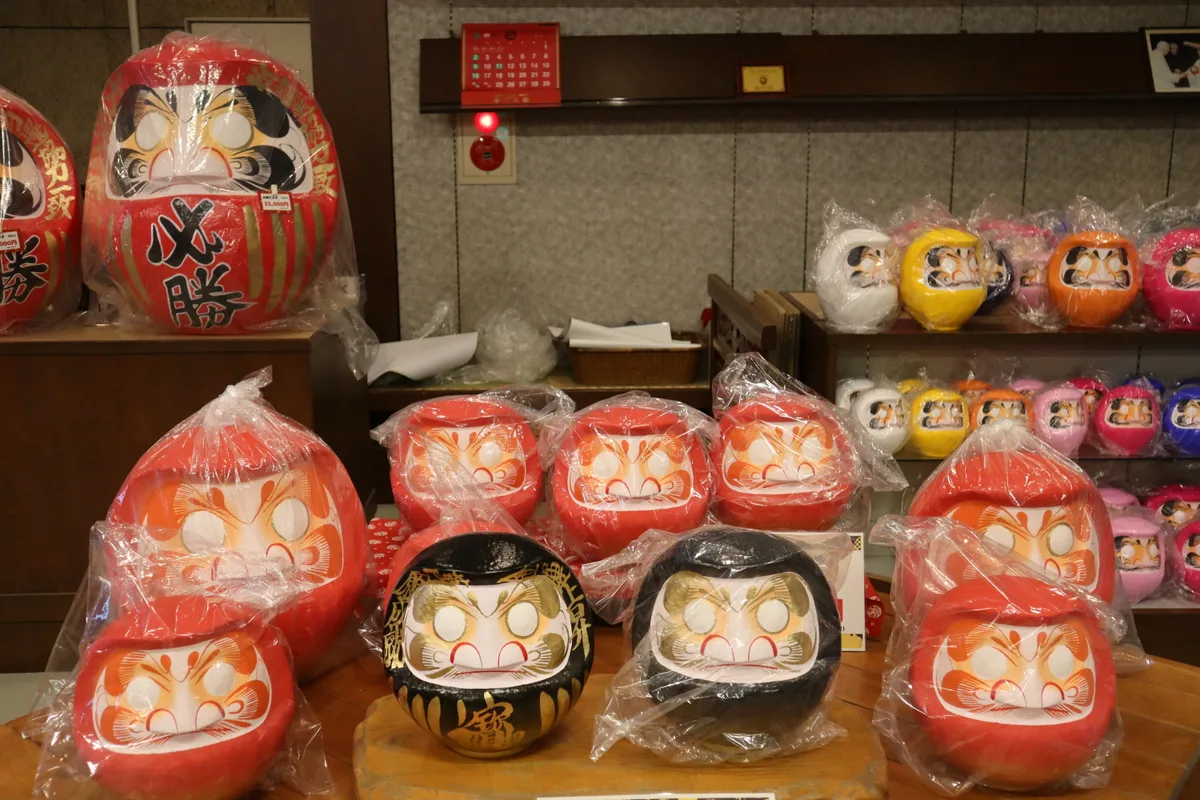
Daimonya's own Q&A says it assigns no fixed meanings to colors. It encourages choosing a color you feel drawn to. A named design can still carry a product-specific message; check the explanation for the doll you actually choose.
For red, white, gold, blue and other colors, compare the named sources in the color reader below. The explanations differ; a color alone does not identify a region, maker or purpose.
Tokiwa's color meanings · Daimonya's color Q&A. Checked October 7, 2026.
CHOOSE A COLOR · READ EVERY SOURCE
Pick one color for a direct answer. The result keeps all four Japan-based readings visible, including omissions and conflicts.
Nine common search choices. No account, upload or universal-color claim.
Strong four-source overlap
Evidence readingAll four guides overlap around general luck or good fortune. The wording is still guidance, not a guarantee attached to every red object.
What to doChoose red when you want the least maker-specific starting point, then keep the wording supplied with the actual doll.
SOURCE-BY-SOURCE COLOR CHECK
This is not another universal color chart. It is a comparison of what four named Japan-based sources actually say, checked on 26 August 2026. The final column explains how much confidence to place in the overlap.
| Color | JNTO · Takasaki | JNTO · Maebashi | Daruma.jp · maker guide | Gunma Official Tourist Guide | Evidence reading |
|---|---|---|---|---|---|
| Red | General wellbeing and good fortune | Good fortune; suitable for general wishes | Luck and good fortune | General good fortune | All four guides overlap around general luck or good fortune. The wording is still guidance, not a guarantee attached to every red object. |
| White | Support for perseverance, including exam stress | Peace | Love and harmony | Not listed in this guide | The three sources that define white disagree. White is the clearest proof that modern color meanings are not one national code. |
| Black | Business venture success | Not listed in this guide | Business venture success | Business success | Three guides closely overlap around business success, while one short guide omits black. That is useful agreement, not a universal rule. |
| Gold / yellow | Gold or yellow: wealth and prosperity | Gold or yellow: wealth | Gold: wealth and prosperity; yellow: financial good fortune | Gold or yellow: wealth and prosperity | The four guides converge on money, wealth or prosperity. The main variation is whether gold and yellow are combined or separated. |
| Purple | Health and longevity | Not listed in this guide | Health and longevity | Health and longevity | Three guides use almost the same wording; the shorter Maebashi guide does not list purple. |
| Blue | Academic success | Academic success | School success and intellectual development | Success in sports and competition | Academic success is the majority reading, but the official Gunma guide shows that blue is not fixed nationally. |
| Green | Physical wellbeing | Health and wellness | Physical health | Strong will | Three guides converge on health or wellbeing. Gunma's official visitor guide instead illustrates green as strong will. |
| Orange | Fertility and safety for children | Not listed in this guide | Pregnancy and safe delivery | Not listed in this guide | The two sources that define orange overlap around pregnancy or child safety. The other two guides omit the color. |
| Pink / peach | Peach: romance and success finding love | Pink: romance | Pink: love, romance and passion | Pink: love | All four guides overlap around love or romance, although they do not use the same color name or exact scope. |
HOW TO CHOOSE A COLOR
First, identify the maker, temple or market. Use the meaning printed on the object, packaging or official product page. That definition belongs to that daruma.
If no definition is supplied, choose by preference. The continuing Takasaki maker guide explicitly says modern meanings vary by store and that color need not carry a deep fixed meaning.
If you want the traditional baseline, choose red. Red has the strongest agreement across the reviewed sources, but it still does not make every red regional object identical.
QUICK ANSWERS
In the blank-eye wishing practice described here, the first painted pupil marks a wish in progress. The other eye is completed at the milestone described by the temple or maker. Our Shorinzan purchase has only the priest's small first dot; the temple instructs the owner to enlarge that eye at home.
It can, depending on the seller. Tokiwa lists protection against misfortune, profitable finances and commercial prosperity for black daruma. Daimonya says its colors have no fixed meanings, although named products can carry a specific message. These are attributed meanings, not one nationwide rule.
The publisher offered ¥1,000, and registration through completion took about 10 minutes on that visit. Neither figure is a standard fee or duration. Shorinzan sets no fixed eye-opening contribution; a doll without its prayer certificate requires an additional ¥1,000 prayer fee per doll.
No. The photos show the publisher's actual purchase from Shorinzan Darumaji. The existing 3D is an illustrative model, not a scan or a reconstruction of that photographed doll.
A Daruma is a Japanese wishing figure modeled on Bodhidharma. It can keep a goal visible, but is not a wish guarantee or one fixed design: material, body and eye state vary by tradition.
Use Daruma doll for the traditional Japanese wishing object. Figure is a useful broad description when the exact material or use is unknown. Use statue or toy only when the specific object is actually sold or documented that way; a folk craft, ornament or souvenir is not automatically a tested children's toy.
For a blank-eye goal Daruma, blank eyes mean the cycle is ready to begin, one painted pupil marks an active goal, and two painted pupils mark the source-defined finish. This is not a rule for every regional form: Mihara City records a Daruma made with both eyes already painted.
A Takasaki Daruma can be tipped over, but its rounded body and a bottom weight called hetta help it return upright. Self-righting does not mean that the doll can never fall, and other regional forms may use different materials or construction.
No. A common blank-eye sequence is to choose one goal, paint one eye, do the work and complete the other eye. But the first-eye direction, whether a regional form begins with blank eyes, and what happens afterward depend on the maker, temple or place connected to the specific Daruma.
Takasaki City describes beginning with the daruma's left eye (on your right when facing it). Practices can vary, so follow guidance from the maker, temple or place where you received the daruma.
Complete the second eye, offer thanks, and follow the return or memorial guidance of the temple or maker connected to your daruma. Do not assume one disposal rule applies everywhere.
No single modern color chart applies to every daruma. Meanings such as study, health or money often vary by maker and seller, so check the source of the specific doll.
Red is the traditional baseline. The 4 Japan-based guides compared here broadly connect red with general luck, good fortune or wellbeing, while the exact wording still belongs to the maker or place.
There is no universal answer. Three of the four reviewed guides define white, linking it separately with perseverance, peace, and love and harmony. The fourth does not list it. Use the definition supplied with the specific doll.
Three of the four Japan-based guides compared here connect black with business success or success in a business venture. One short guide does not list black, and the maker's wording still controls the specific object.
The four reviewed guides broadly connect gold or yellow with money, wealth or prosperity. Some sources combine gold and yellow while a maker may define them separately, so check the specific product wording.
Daruma is the Japanese name for Bodhidharma, a monk connected with the early formation of Chan Buddhism in China. The broad historical core is stronger than the detailed stories later attached to his biography.
The familiar rounded wishing doll called daruma is Japanese. Its name and face come from Bodhidharma, a monk whom the cited temple describes as Indian and whom Buddhist tradition connects with Chan in China. In the e-Museum record, the Chinese form of the name is Damo; Daruma is the Japanese form.
Not as a simple category. The temple and museum sources cited here describe Daruma as Bodhidharma, a Buddhist monk and Zen patriarch, while the familiar doll is an auspicious wishing figure modeled on him. Some temple and household practices treat a Daruma with religious respect, so the answer is more precise than calling it either a god or a purely secular toy.
The familiar doll connects several periods: Bodhidharma belongs to the early Chan story, Japanese Daruma portraits are documented centuries later, and Shorinzan's lucky papier-mâché Daruma is described in a late-eighteenth-century Takasaki setting. That local lineage should not be treated as an invention date for every regional form.
Keep the Daruma visible and continue the work tied to the original goal. In the common goal-tracking sequence, the unfinished eye marks work still in progress; complete it only at the milestone defined by the maker, temple or place connected to your Daruma.
Check the current guidance from the temple, shrine, maker or market connected to the object. Return and memorial practices differ; there is no single disposal method or one-year expiry rule for every Daruma.
No. The sources cited here describe organized memorial or o-takiage contexts run by a temple, shrine, cooperative or local event. Confirm that a source accepts your object and follow its current rules; do not treat a public ceremony as permission for a private fire or postal return.
A Daruma is modeled on Bodhidharma and commonly keeps a goal or wish visible through its self-righting form and, in some traditions, an eye ritual. A maneki-neko is a beckoning cat whose raised paw is associated with welcoming people, prosperity or good fortune. Their local forms and practices vary.
The official cultural sources cited here describe the traditional Daruma as a good-luck or wishing figure modeled on Bodhidharma; they do not classify that object as a yokai. A fictional character or artwork called Daruma can still be written as a yokai without changing the traditional object's category.
No traditional curse is part of the Daruma use documented by the official sources cited here. Horror films, games and online stories may reuse its name or face; treat those claims as fiction or modern storytelling unless a named cultural source supports a different statement.
READ THE OFFICIAL GUIDANCE