Daruma kanji: what is written on the doll, and what it means.
Start with the name: だるま, ダルマ and 達磨. Then separate that name from five wishes documented by Takasaki City and check what each source can—and cannot—tell you.
One proverb · three name forms · six inscription records · sources checked 27 August 2026
KANJI CHART · SIX DOCUMENTED TEXTS
What does the kanji on a Daruma doll mean?
The name 達磨 plus the five wishes Takasaki City documents on its Daruma. English lines are Atlas readings in context; other makers and regions can use different lettering.
Kanji on a Daruma doll: reading, meaning and where it appears
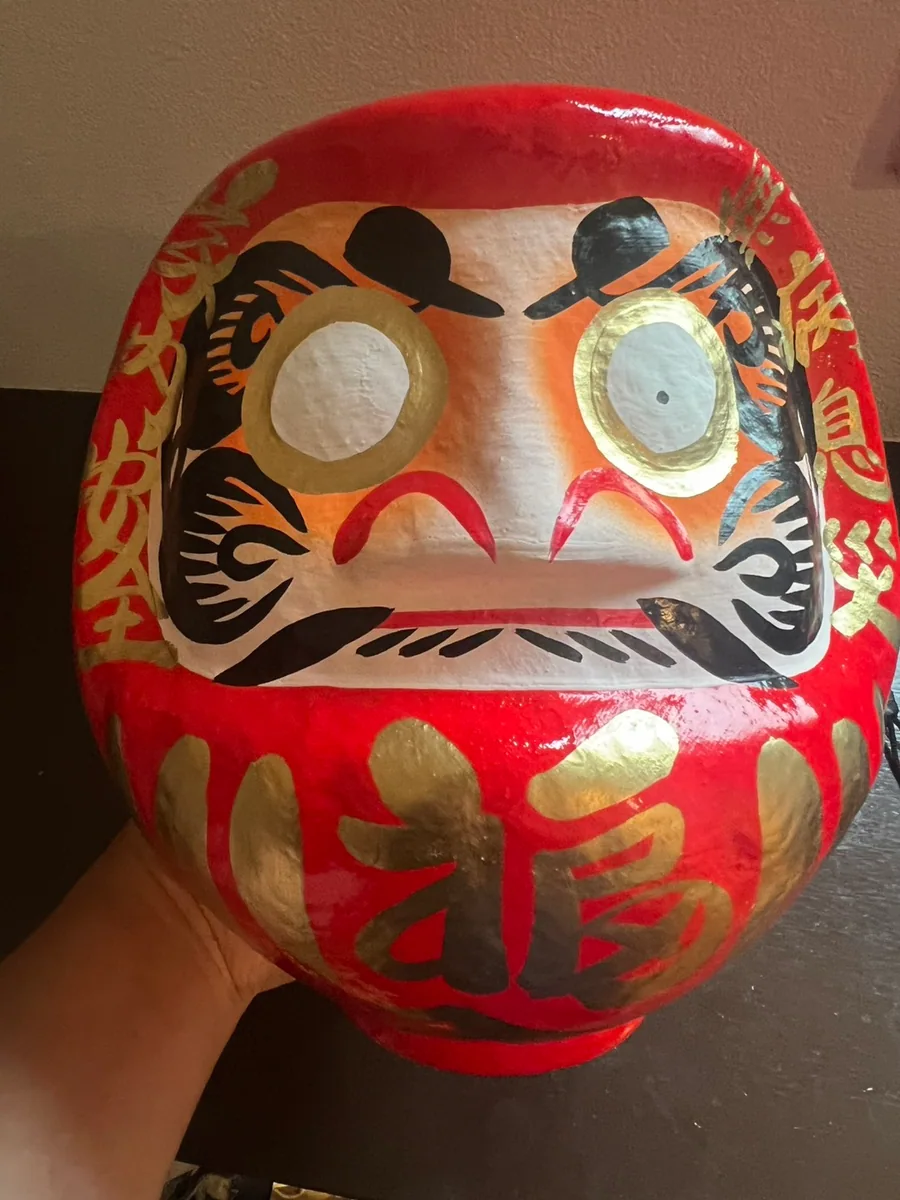
The large belly character on our Shorinzan Darumaji purchase is 福 (fuku, good fortune). It is not safe to read an extra 入 into this photograph. The chart above explains 福入 as a separate inscription documented by Takasaki City.
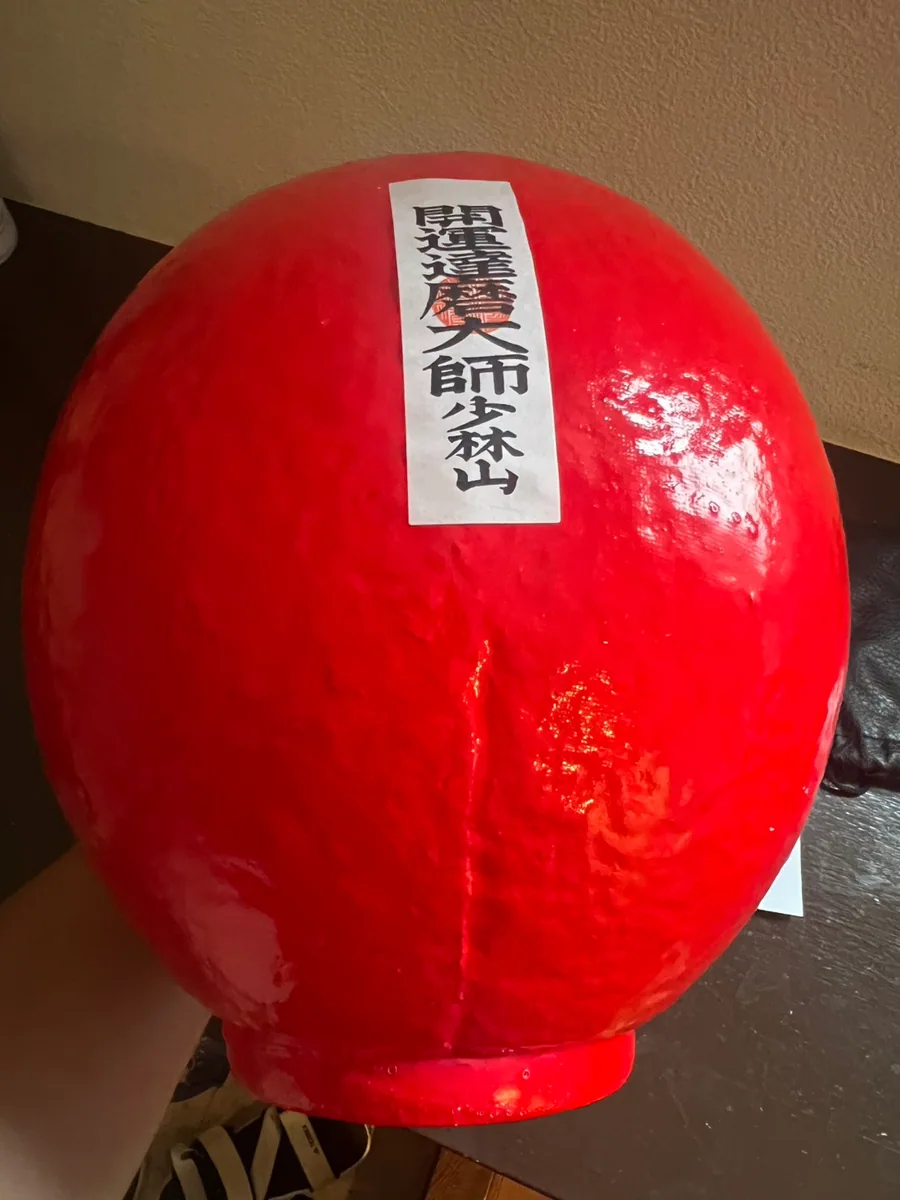
福 (fuku): good fortune. 家内安全 (kanai anzen) expresses a wish for household safety; 無病息災 (mubyo sokusai) a wish for good health and freedom from illness. These are wishes, not promised outcomes.少林山 (Shorinzan) on the rear label names the temple. A place label is different from a wish on the belly; the photos do not establish the individual maker.
祈願 (kigan) means a prayer or wish; it is not an inscription we can verify on this purchased object. The photographs support the characters shown here, not every possible daruma inscription.
Publisher's original object photographs and the temple's supplied eye-opening instructions, checked October 7, 2026. English meanings are our contextual translations. See all five photographs of the same doll.
THE SHORT ANSWER
The boldest text is not always the doll's name.
達磨 is the name. It is the established Japanese name Daruma, connected with Bodhidharma—not a two-character motivational slogan.
Body text often carries a wish. On the Takasaki form documented by the city, 福入 appears on the belly while four longer wishes appear on the shoulders. A maker may also offer different or custom lettering.
Read the phrase before reading the object. Matching text cannot establish who made a doll, how old it is or whether the design is authentic.
DARUMA IN ENGLISH
Keep the name Daruma. Translate the context.
Short answer: the English name is still Daruma. Add a plain-English gloss only when the reader needs to know whether you mean the doll or the monk.
Name
Daruma
Use the romanized Japanese name in English.
Object
Daruma doll
For an unfamiliar audience, “Japanese good-luck doll” is a useful first-mention explanation.
Person
Bodhidharma
Use the monk's name when the subject is the historical or religious figure rather than the object.
Translation boundary: Daruma is not literally English for “doll,” “wish” or “perseverance.” Those words explain the object and its associations. Official English-language Japanese sources retain Daruma, then explain the doll as modeled on Bodhidharma.
This is the Japanese saying most closely associated with a self-righting Daruma. Takasaki City connects the doll's return to an upright position with a calm, patient response to difficulty; Gunma's official English guide uses the line to explain perseverance.
Use it for
A resilience caption, encouragement or explanation of why the rounded doll gets back up.
Do not confuse it with
The text painted on the object. A Takasaki doll may instead carry wishes such as 福入 or 大願成就.
Authorship boundary
The responsible sources call it a Japanese saying. They do not establish it as a quotation spoken by Bodhidharma.
Japanese counts だ・る・ま as three mora, or haku. The Japan Foundation notes that each haku has approximately the same length. The museum's English respelling is a learner aid, not a full phonetic transcription.
Hear community recordings ↗Forvo hosts third-party community recordings. Daruma Atlas does not copy, edit or authenticate the voices.
Match exact characters, then check the reading, likely role and evidence boundary. This is a controlled phrase guide—not camera OCR, object authentication or a universal catalog of every maker's lettering.
EXACT TEXT福入
fuku-iri
Good-fortune inscriptionBelly on the Takasaki form described by the city
Fortune enters; an inscription welcoming good fortune.
What the source supports
Takasaki City names 福入 as the gold-painted belly inscription on Takasaki Daruma and describes the writing as carrying a wish.
What this reading cannot prove
“Fortune enters” is an Atlas contextual reading, not an official municipal translation. Lettering and placement can vary by maker and object.
These English lines are contextual readings for field use. They do not replace a maker's explanation and do not turn one Takasaki record into a rule for every region.
01
達磨daruma
The Japanese name · A name for the figure, not a wish inscription
Daruma; the Japanese name used for Bodhidharma and the doll modeled on him.
A major Japanese dictionary record treats 達磨 as a transcription and name connected with Bodhidharma, then separately records the familiar doll.
Boundary: Do not invent a slogan by translating 達 and 磨 one character at a time. Here the pair functions as the established name Daruma, not as a two-kanji wish.
Good-fortune inscription · Belly on the Takasaki form described by the city
Fortune enters; an inscription welcoming good fortune.
Takasaki City names 福入 as the gold-painted belly inscription on Takasaki Daruma and describes the writing as carrying a wish.
Boundary: “Fortune enters” is an Atlas contextual reading, not an official municipal translation. Lettering and placement can vary by maker and object.
A chosen kanji is possible in one documented workshop context—not promised everywhere.
The Gunma Official Tourist Guide describes a craftsperson painting a kanji of the visitor's choice on the stomach or back. Treat that as evidence for that experience, not as a universal menu, booking promise or entitlement to copy a workshop's distinctive hand.
The large gold belly character on our Shorinzan purchase is 福 (fuku), meaning good fortune. Do not add an 入 that the photograph does not clearly show. 福入 is a separately documented Takasaki inscription, explained in the six-entry chart.
What does 祈願 mean, and is it on this photographed doll?
祈願 (kigan) means a prayer or wish. The photographs here do not establish that inscription on the purchased doll. They show 福 on the belly and 家内安全 and 無病息災 at the sides; do not treat every prayer-related phrase as lettering visible on this object.
What does Daruma mean in English?
Keep Daruma as the romanized Japanese name. On first mention, “Daruma doll” or “Japanese good-luck doll” can explain the object; use “Bodhidharma” when referring to the monk. Doll, wish and perseverance are contextual explanations—not literal English translations of Daruma.
How do you write Daruma in Japanese?
Three useful forms are だるま in hiragana, ダルマ in katakana and 達磨 as the established kanji name. They represent the name; they do not prove the origin or meaning of a particular doll.
How do you pronounce Daruma?
A beginner English approximation is “dah-roo-mah.” Then keep だ・る・ま as three short, approximately even Japanese mora. The respelling is a learner aid; use the linked community recordings to hear actual speakers.
What is the famous Daruma quote?
The saying most closely associated with the self-righting doll is 七転び八起き (nana korobi ya oki), commonly rendered in English as “seven times down, eight times up.” Official Takasaki and Gunma sources connect it with persistence and the doll returning upright. They present it as a Japanese saying—not as a verified quotation spoken by Bodhidharma.
What is written on a daruma doll?
There is no single required inscription. Takasaki City documents 福入 on the belly and wishes including 家内安全, 商売繁盛, 大願成就 and 目標達成 on the shoulders of Takasaki Daruma. Other makers and regional forms can differ.
What does 達磨 mean on a daruma?
達磨 is the established Japanese name Daruma, connected with Bodhidharma. It should not be decoded as a modern wish by translating the two characters separately.
What does 福入 mean on a daruma?
Takasaki City documents 福入 on the belly of Takasaki Daruma. Daruma Atlas renders it contextually as “fortune enters” or an inscription welcoming good fortune; that English wording is an Atlas paraphrase, not an official city translation.
Can a workshop paint a custom kanji?
The Gunma Official Tourist Guide describes a craftsperson painting a visitor's chosen kanji on the stomach or back in one workshop context. That does not guarantee the same option, language support, price or availability everywhere; check the current provider page.
Can I copy the calligraphy from a daruma?
You can copy the exact Unicode phrase for reference. A phrase and a maker's brushwork, composition, logo or protected design are not the same thing. Ask the maker before reproducing a distinctive commercial or artistic treatment.
Does this reader identify an old or authentic daruma?
No. It matches six documented text strings only. It does not identify a maker, date an object, authenticate origin, value a doll or decode ambiguous calligraphy from an image.
USE AND RIGHTS BOUNDARY
Text recognition is not object recognition.
Translation: Atlas English is contextual paraphrase unless a source explicitly supplies English.
Identification: no image is uploaded, stored or analyzed. This reader does not authenticate, date, value or attribute an object.
Reproduction: a generic phrase does not automatically grant rights to reproduce an artisan's exact brushwork, composition, logo or protected product design.