Takasaki Daruma
高崎だるま · Takasaki
A rounded lucky daruma whose eyebrows evoke cranes and whose mustache evokes turtles.
REGIONAL ATLAS · BATCH 02
Daruma dolls differ by region in silhouette, material, face, decoration and eye custom. Use the atlas to identify those differences—not to force every object into one generic red-doll template.
DIRECT ANSWER · REGIONAL TYPES
This atlas documents 15 regional forms—not a final national count. Japan's Daruma field includes local names, workshop variation, revivals and related self-righting folk objects. Atlas files stay limited to forms with a traceable place and evidence trail.
Use five shared clues—place, material, silhouette, face and eyes—before treating two objects as the same type. Color alone is not enough.
FIND A REGIONAL FORM
15 of 15 objects shown
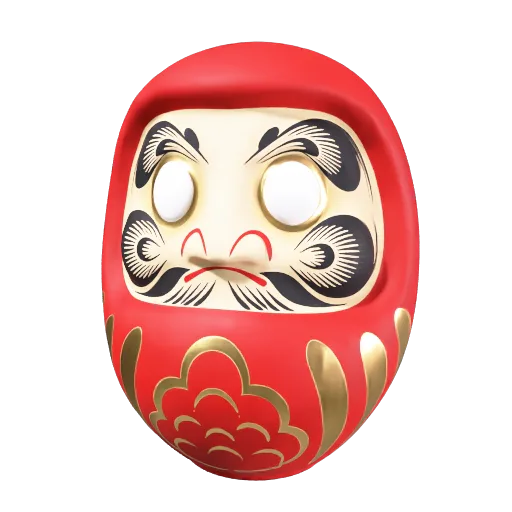 INTERPRETIVE 3D · PBR · Rounded and full-bodied
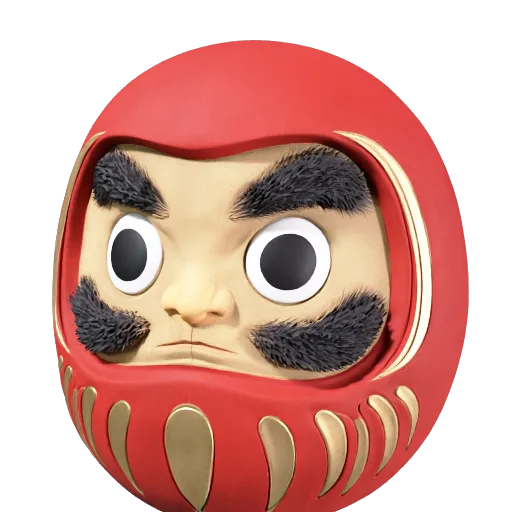
高崎だるま · Takasaki
A rounded lucky daruma whose eyebrows evoke cranes and whose mustache evokes turtles.
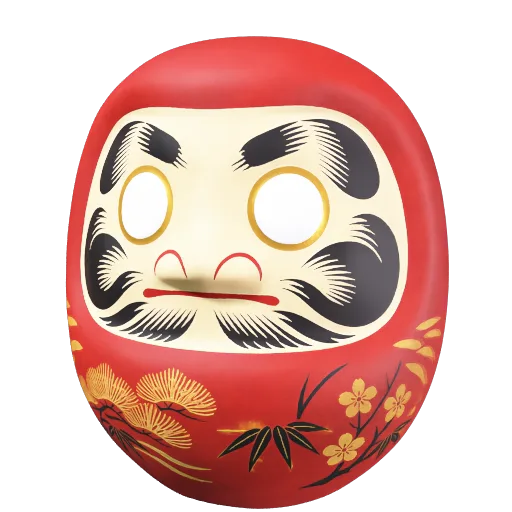 INTERPRETIVE 3D · PBR · Rounded, with a gentle face
白河だるま · Shirakawa
A rounded, gentle-faced form whose painted face combines crane, turtle, pine, bamboo and plum motifs.
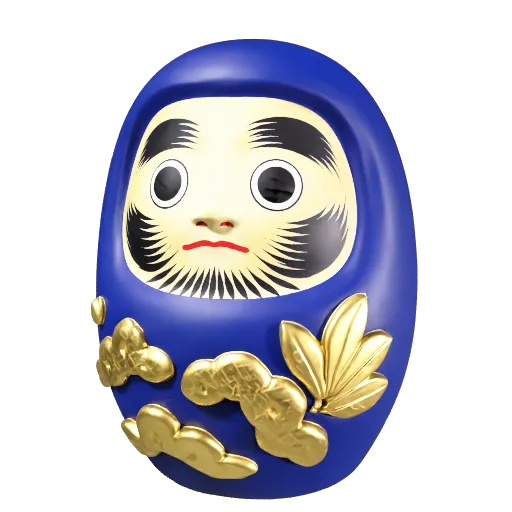 INTERPRETIVE 3D · PBR · Tall northern profile
松川だるま · Sendai
A Sendai papier-mâché daruma with blue around the face and raised decorative appliqué on the body.
 INTERPRETIVE 3D · PBR · Tall with a flat crown
三春だるま · Miharu
A tall northeastern form with a flat crown, already-painted eyes, long brows and a vivid indigo face outline.
 INTERPRETIVE 3D · PBR · Balanced Kanto profile
越谷だるま · Koshigaya
A pale-complexioned Kanto form known for a slightly higher nose and a refined, gentle expression.
 INTERPRETIVE 3D · PBR · Soft, rounded profile
鈴川だるま · Fuji
A gentle local form with restrained facial hair, closely tied to Fuji's Bishamonten Daruma Market.
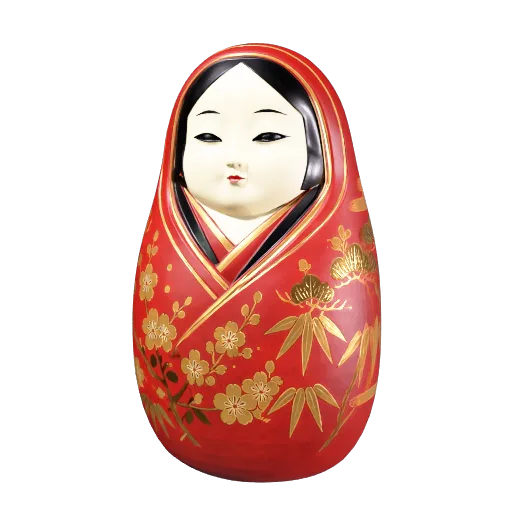 INTERPRETIVE 3D · PBR · Rounded female okiagari form
姫だるま · Taketa
A female daruma with narrow eyes, a small red mouth and layered red robes carrying pine, bamboo and plum motifs.
 INTERPRETIVE 3D · PBR · Compact rounded profile
松本だるま · Matsumoto
A warm-faced Shinshu form whose eyebrows and beard are built from dyed hemp fibers rather than brushwork alone.
 INTERPRETIVE 3D · PBR · Tall and compact
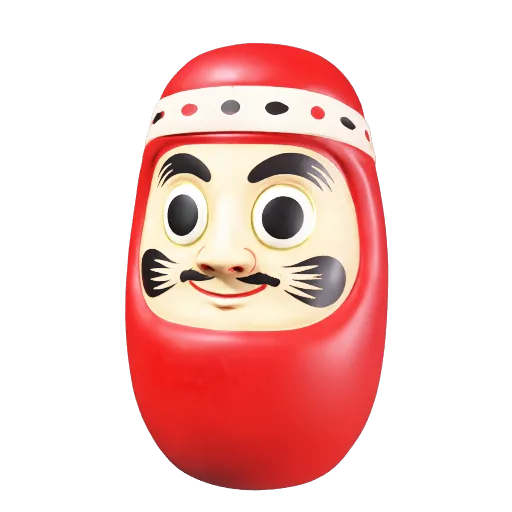
三原だるま · Mihara
A tall, fist-sized form with a bean-pattern headband, wide-open eyes and a small sound inside.
 INTERPRETIVE 3D · PBR · Triangular and sharply tapered
三角だるま · Agano
A pointed Echigo daruma whose triangular body and humorous expression break the familiar round silhouette.
 INTERPRETIVE 3D · PBR · Rounded white body with belly figure
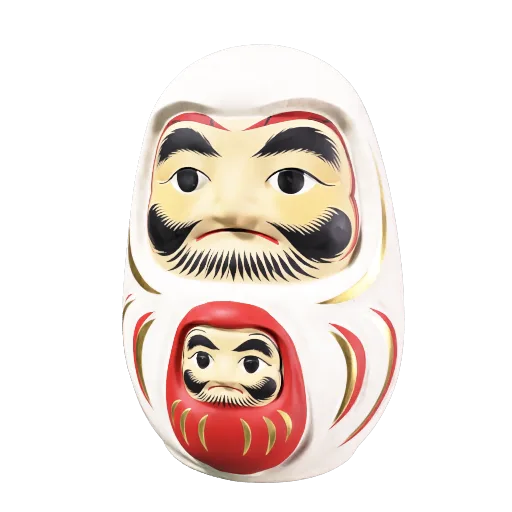
甲州親子だるま · Kofu
A white parent daruma with a smaller bearded child embedded visibly in its belly.
 INTERPRETIVE 3D · PBR · Slender, upright and asymmetrical
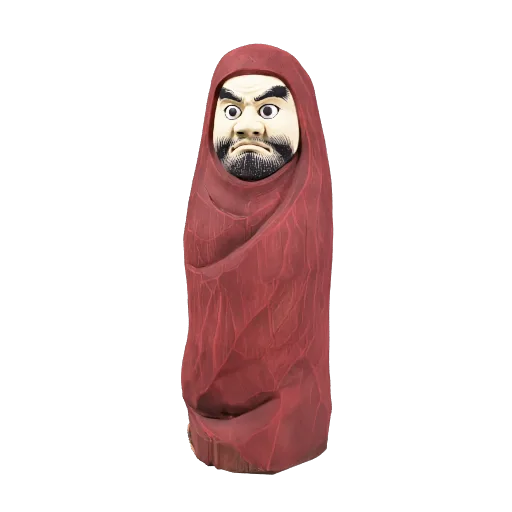
善知鳥彫だるま · Aomori
A slender, deep-crimson daruma carved directly from split wood, appearing to rise from meditation.
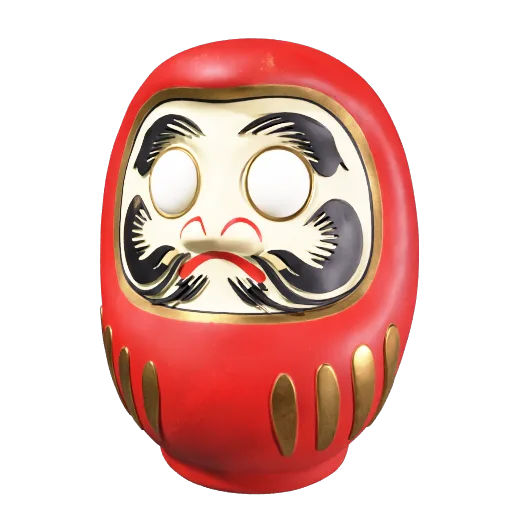 INTERPRETIVE 3D · PBR · Rounded Tama workshop family
多摩だるま · Mizuho
A handmade western-Tokyo daruma tradition whose faces and proportions visibly vary from workshop to workshop.
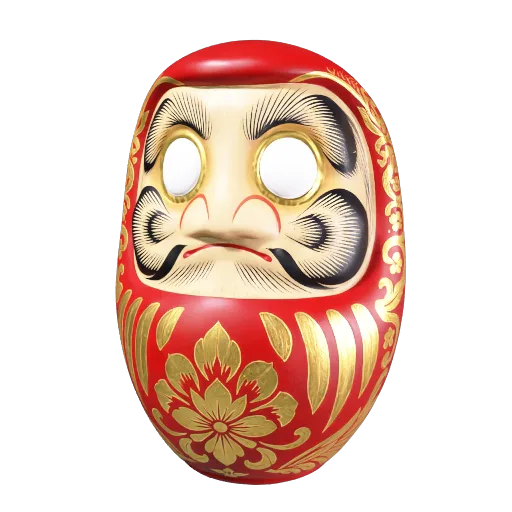 INTERPRETIVE 3D · PBR · Rounded with close-detail emphasis
相州だるま · Hiratsuka
A fine-haired Kanagawa form with ornate gold patterning and distinctive gold treatment around the eyes.
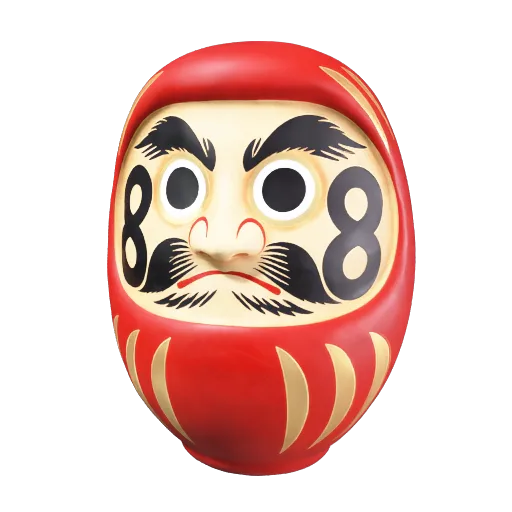 INTERPRETIVE 3D · PBR · Rounded historic form
藤枝だるま · Fujieda
A revived Shizuoka tradition remembered for strong figure-eight sideburns on the historic local daruma face.
DARUMA FACE MEANING · REGIONAL MAP
Short answer: it is not necessarily an angry face. On the two source-documented regional forms compared here, bold brows and facial hair carry auspicious motifs: Takasaki foregrounds the crane and turtle; Shirakawa maps five motifs across distinct facial zones. Expression still varies by artisan and region.
If “Daruma doll head” means a painted head sitting on separate colored blocks, that is Daruma Otoshi, a wooden skill game—not the face or detachable head of a wishing Daruma.
This location diagram is an evidence reader—not an artisan pattern, tracing sheet, authentication tool or license to reproduce workshop-specific brushwork.
高崎だるま
The face is not generic decoration: Takasaki City identifies crane-shaped eyebrows and a turtle-like beard, with gold wish lettering beside the face.
The thick eyebrows evoke cranes. The official English guide pairs the crane with longevity symbolism.
Drawing boundary: Study the crane-like sweep without copying a named workshop's exact brush signature.
Profile boundary: These are regional motifs, not one fixed drawing template. Takasaki faces are hand-painted, so line weight, cheek color and expression vary by artisan.
ALL TEN SOURCE-BOUNDED READINGS
The map is interactive. This complete comparison remains available without script.
| Region | Face zone | Documented motif | What the source supports | Do not assume |
|---|---|---|---|---|
| Takasaki DarumaTakasaki, Gunma | Blank pupils | A wish in progress | Takasaki City gives one local sequence: facing the doll, fill the pupil on your right while making the wish, then the other after a safe year or fulfillment. | Do not turn this Takasaki example into a national rule; other regional types can arrive with both eyes painted. |
| Takasaki DarumaTakasaki, Gunma | Eyebrows | Crane | The thick eyebrows evoke cranes. The official English guide pairs the crane with longevity symbolism. | Study the crane-like sweep without copying a named workshop's exact brush signature. |
| Takasaki DarumaTakasaki, Gunma | Mustache and beard | Turtle | The facial hair evokes a turtle, paired with the crane as an auspicious longevity motif. | The source supports the motif—not one universal curl count, spacing or stroke order. |
| Takasaki DarumaTakasaki, Gunma | Gold writing beside the face | The owner's wish | Takasaki City identifies gold writing on both shoulders for wishes such as business prosperity, household safety or goal achievement. | Do not reproduce workshop-specific calligraphy, names or maker marks without permission. |
| Takasaki DarumaTakasaki, Gunma | The whole expression | Hand-painted variation | The regional vocabulary is shared, but the finished face still carries the individual artisan's line weight and expression. | Use this map to read categories. It cannot identify a maker or authenticate an object from appearance alone. |
| Shirakawa DarumaShirakawa, Fukushima | Eyebrows | Crane | Shirakawa City identifies the eyebrows as the crane element in the face-wide auspicious composition. | The map names the motif location, not an exact wing shape or workshop stroke. |
| Shirakawa DarumaShirakawa, Fukushima | Beard | Turtle | The beard supplies the turtle element in Shirakawa's crane-turtle-pine-bamboo-plum set. | Do not infer maker, age or authenticity from a turtle-like curl alone. |
| Shirakawa DarumaShirakawa, Fukushima | Chin beard | Pine + bamboo | The municipal description places both pine and bamboo in the chin-beard treatment. | The source supports the paired motif location, not a reusable line pattern. |
| Shirakawa DarumaShirakawa, Fukushima | Sideburns | Pine + plum | Shirakawa City places pine and plum in the sideburn treatment around the face. | Treat this as an observation key; exact spacing and brush rhythm remain artisan work. |
| Shirakawa DarumaShirakawa, Fukushima | The whole face | Crane · turtle · pine · bamboo · plum | The five motifs work as one auspicious face composition, and the city names the Watanabe and Sagawa families as continuing bearers of the skill. | A five-motif resemblance is still not object-level provenance or permission to copy a family's design. |
Shirakawa and Miharu share a prefecture, yet their recorded silhouettes, expressions and eye treatments diverge. Place is evidence—not a shortcut to one universal design.
Shirakawa, Fukushima
Miharu, Fukushima
Takasaki is rounded and full-bodied. Echigo Sankaku Daruma is sharply triangular. Both sit inside the paper-craft field without sharing one body template.
Takasaki, Gunma
Agano, Niigata
The familiar Takasaki wish ritual uses blank pupils. Matsukawa Daruma is documented with painted eyes. The atlas keeps those practices separate instead of teaching one national rule.
Takasaki, Gunma
Sendai, Miyagi
Takasaki uses painted papier-mâché. Aomori's Utōbori tradition is carved from split wood, with an upright, asymmetric profile that a front-only red-doll guide can miss.
Takasaki, Gunma
Aomori, Aomori
Takasaki carries crane-and-turtle facial motifs. Taketa Hime Daruma is documented with a female face and layered robes. Regional identity reaches beyond decoration.
Takasaki, Gunma
Taketa, Oita
Matsukawa Daruma is the blue-framed Sendai form with raised body ornament. Matsumoto Daruma is the Nagano form with black-dyed hemp eyebrows and beard. Keep the place and material together.
Sendai, Miyagi
Matsumoto, Nagano
15-REGION EVIDENCE MATRIX
One row per source-mapped atlas record. Read the shared fields side by side, open the claim-level evidence, or send any row into the same three-object comparison.
Scroll horizontally to compare every field. Each row remains one complete regional record.
| File | Regional type | Place | Material | Silhouette | Face | Eyes | Evidence | Compare |
|---|---|---|---|---|---|---|---|---|
| 001 | Takasaki Daruma高崎だるま | Takasaki, Gunma | Painted papier-mâché | Rounded and full-bodied | Crane + turtle | Blank until a wish is made | Open file | Compare |
| 002 | Shirakawa Daruma白河だるま | Shirakawa, Fukushima | Painted papier-mâché | Rounded, with a gentle face | Crane, turtle, pine, bamboo + plum | Commonly sold with blank pupils today | Open file | Compare |
| 003 | Matsukawa Daruma松川だるま | Sendai, Miyagi | Painted papier-mâché + raised appliqué | Tall northern profile | Blue surround + applied ornament | Traditionally painted eyes | Open file | Compare |
| 004 | Miharu Daruma三春だるま | Miharu, Fukushima | Painted papier-mâché | Tall with a flat crown | Long brows + dense beard + indigo outline | Both eyes painted from the start | Open file | Compare |
| 005 | Koshigaya Daruma越谷だるま | Koshigaya, Saitama | Painted papier-mâché | Balanced Kanto profile | Pale complexion + slightly raised nose | Blank pupils for the wish ritual | Open file | Compare |
| 006 | Suzukawa Daruma鈴川だるま | Fuji, Shizuoka | Painted papier-mâché | Soft, rounded profile | Restrained beard + calm expression | Blank pupils; local order varies by year | Open file | Compare |
| 007 | Hime Daruma姫だるま | Taketa, Oita | Painted papier-mâché with weighted base | Rounded female okiagari form | Narrow eyes + small red mouth + layered robe | Eyes fully painted | Open file | Compare |
| 008 | Matsumoto Daruma松本だるま | Matsumoto, Nagano | Painted papier-mâché + dyed hemp fiber | Compact rounded profile | Warm complexion + applied fiber brows and beard | Fully painted | Open file | Compare |
| 009 | Mihara Daruma三原だるま | Mihara, Hiroshima | Painted papier-mâché with an internal bell or stone | Tall and compact | Bean-pattern headband + wide eyes | Both eyes painted from the start | Open file | Compare |
| 010 | Sankaku Daruma三角だるま | Agano, Niigata | Painted papier-mâché | Triangular and sharply tapered | Humorous expression + pointed crown | Fully painted | Open file | Compare |
| 011 | Koshu Oyako Daruma甲州親子だるま | Kofu, Yamanashi | Painted papier-mâché | Rounded white body with belly figure | Parent face + small bearded child | Parent eyes angled toward the viewer | Open file | Compare |
| 012 | Utoubori Daruma善知鳥彫だるま | Aomori, Aomori | Split wood carved with a single knife tradition | Slender, upright and asymmetrical | Forward gaze + deep-crimson robe | Fully carved and painted | Open file | Compare |
| 013 | Tama Daruma多摩だるま | Mizuho, Tokyo | Hand-painted papier-mâché | Rounded Tama workshop family | Balanced brows + workshop-to-workshop variation | Varies by maker; confirm the object | Open file | Compare |
| 014 | Soshu Daruma相州だるま | Hiratsuka, Kanagawa | Painted papier-mâché with gold decoration | Rounded with close-detail emphasis | Fine hair + ornate gold surround | Blank pupils; rare gold-eye variant documented | Open file | Compare |
| 015 | Fujieda Daruma藤枝だるま | Fujieda, Shizuoka | Painted papier-mâché | Rounded historic form | Figure-eight sideburns | Fully painted in the documented revival | Open file | Compare |
Reading boundary: these are source-bounded atlas descriptions, not physical measurements, authenticity verdicts or proof that every workshop uses one fixed design. Eye customs and painted details can vary by maker, date and use.
PUBLICATION GATE
Every file needs a municipal, museum, official tourism or continuing-maker source.
Silhouette, color zone or raised material may be shown; copied artisan marks and invented lettering are excluded.
Front, right, back, left and oblique views use a shared stage so differences remain visible.